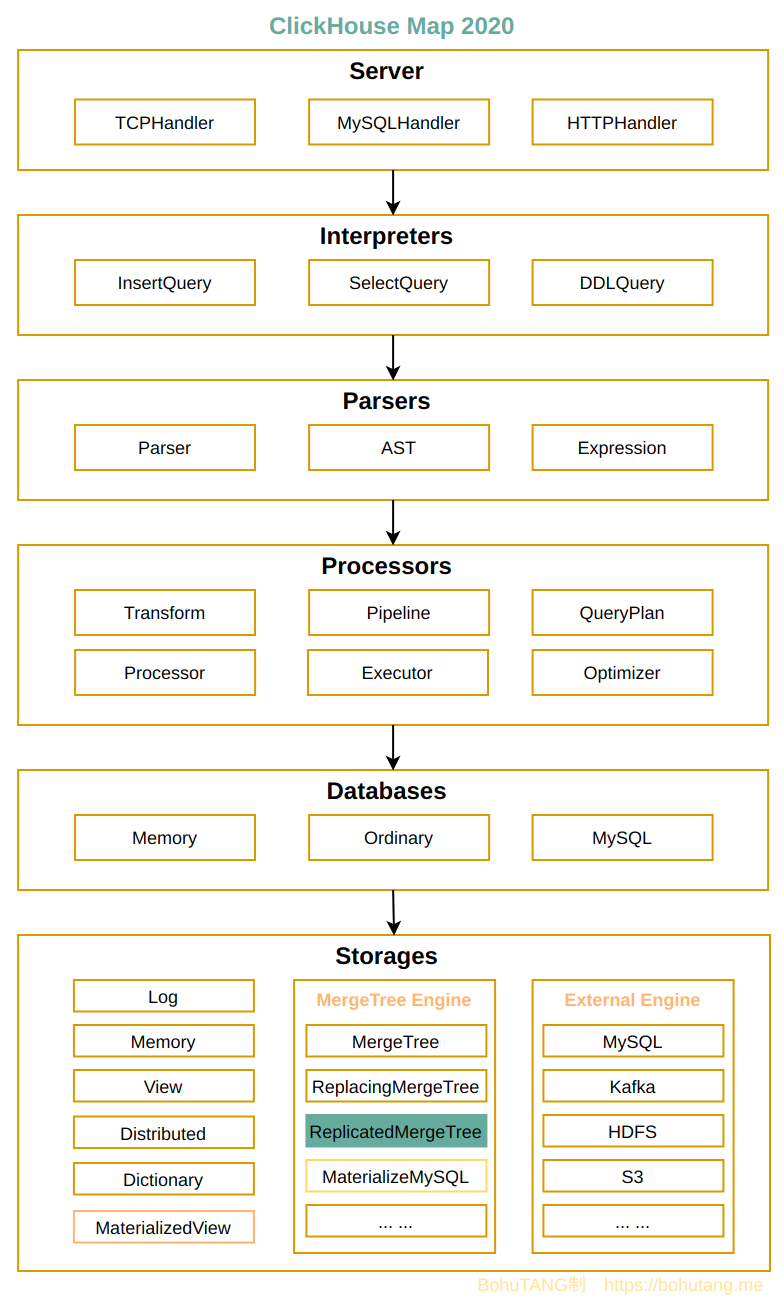
ClickHouse and Friends (13) ReplicatedMergeTree Engine and Synchronization Mechanism
Last updated: 2020-09-13
In MySQL, to ensure high availability and data safety, master-replica mode is adopted, with data synchronized through binlog.
In ClickHouse, we can use the ReplicatedMergeTree engine, with data synchronization completed through zookeeper.
This article starts with setting up a multi-replica cluster, then takes a peek at the underlying mechanism for a simple taste.
1. Cluster Setup
Set up a 2-replica test cluster. Due to limited resources, we’ll start clickhouse-server (2 replicas) + zookeeper (1) on the same physical machine. To avoid port conflicts, the two replica ports will be different.
1.1 ZooKeeper
1
docker run -p 2181:2181 --name some-zookeeper --restart always -d zookeeper
CREATE TABLE default.rtest1 ON CLUSTER 'mycluster_1'
(
    `id` Int64,
    `p` Int16
)
ENGINE = ReplicatedMergeTree('/clickhouse/tables/replicated/test', '{replica}')
PARTITION BY p
ORDER BY id
s1. replica-1> StorageReplicatedMergeTree::write --> ReplicatedMergeTreeBlockOutputStream::write(const Block & block) s2. replica-1> storage.writer.writeTempPart, write to local disk s3. replica-1> ReplicatedMergeTreeBlockOutputStream::commitPart s4. replica-1> StorageReplicatedMergeTree::getCommitPartOp, commit LogEntry to zookeeper, information includes: ReplicatedMergeTreeLogEntry { type: GET_PART, source_replica: replica-1, new_part_name: part->name, new_part_type: part->getType } s5. replica-1> zkutil::makeCreateRequest(zookeeper_path + "/log/log-0000000022"), update log_pointer to zookeeper
s6. replica-2> StorageReplicatedMergeTree::queueUpdatingTask(), scheduled pull task s7. replica-2> ReplicatedMergeTreeQueue::pullLogsToQueue, pull s8. replica-2> zookeeper->get(replica_path + "/log_pointer"), get current replica's synchronized position from zookeeper s9. replica-2> zookeeper->getChildrenWatch(zookeeper_path + "/log"), get all LogEntry information from zookeeper s10. replica-2> Filter LogEntries needing synchronization from all LogEntries based on sync position log_pointer, write to queue s11. replica-2> StorageReplicatedMergeTree::queueTask, consume queue tasks s12. replica-2> StorageReplicatedMergeTree::executeLogEntry(LogEntry & entry), execute consumption based on LogEntry type s13. replica-2> StorageReplicatedMergeTree::executeFetch(LogEntry & entry) s14. replica-2> StorageReplicatedMergeTree::fetchPart, download part directory data from replica-1's interserver_http_port s15. replica-2> MergeTreeData::renameTempPartAndReplace, write files locally and update in-memory meta information s16. replica-2> Data synchronization complete
You can also enter the zookeeper docker container to directly view a LogEntry:
1 2 3 4 5 6 7
[zk: localhost:2181(CONNECTED) 85] get /clickhouse/tables/replicated/test/log/log-0000000022
format version: 4
create_time: 2020-09-13 16:39:05
source replica: s1
block_id: 33_2673203974107464807_7670041793554220344
get
33_2_2_0
3. Summary
This article uses writes as an example to analyze from the bottom layer how ClickHouse ReplicatedMergeTree works. The logic is not complex.
Data synchronization between different replicas requires zookeeper (currently community members are working on etcd integration pr#10376) for metadata coordination. It’s a publish/subscribe model. For specific data directories, you need to go to the corresponding replica and download through the interserver_http_port.
Replica synchronization is all file directory-based. This brings a benefit: we can easily implement ClickHouse storage-compute separation. Multiple clickhouse-servers can simultaneously mount the same data for computation, and each of these servers is writable. Tiger Brother has already implemented a working prototype. For details, see the next article .